
AUA 2026 - BPH/LUTS Preview

The AUA 2026 Annual Meeting opens tomorrow in Washington, DC. For those tracking BPH/LUTS, the program is dense across surgical, device, medical, and digital health innovation. A few threads worth sharing for colleagues who can't be on the floor:
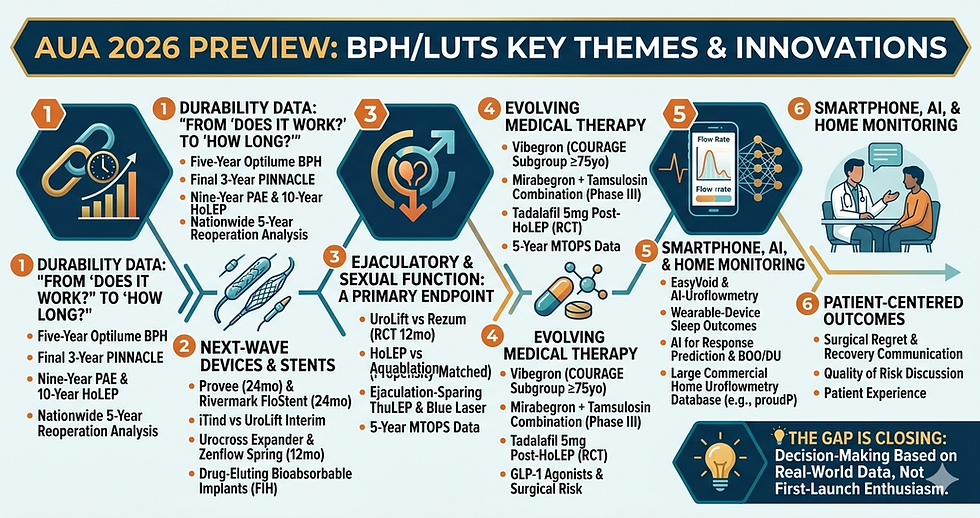
Long-term and real-world durability data is catching up to the proliferation of options. Five-year Optilume BPH (EVEREST, IP21-21) and final three-year PINNACLE results (PD03-09), three-year multicenter Rezum in large glands (IP54-12, IP54-24), nine-year PAE follow-up (IP21-18), 10-year HoLEP via Epic Cosmos (PD03-14), and a nationwide five-year reoperation analysis across eight procedures (IP21-22). The conversation is shifting from "does it work?" to "how does it hold up?"
The next wave of devices and stents is well represented. 24-month outcomes from the Provee prostatic urethral stent (IP21-01) and its new delivery system (IP21-02), 24-month Rivermark FloStent (RAPID-II, PD03-02), iTind vs UroLift interim results (MT-08, IP21-03), Urocross Expander 12-month and intentional retrieval data (IP03-08, IP21-26), Zenflow Spring System 12-month satisfaction (IP29-27), the ALPFA GRAIL system (IP21-15), and first-in-human intraprostatic drug-eluting bioabsorbable implants (IP21-17, IP54-09).
Ejaculatory and sexual function has become a primary endpoint, not an afterthought. CLEAR RCT 12-month results (UroLift vs Rezum, IP54-03), HoLEP vs Aquablation propensity-matched analyses (IP54-04), 5-year MTOPS sexual function data (IP03-06), ejaculation-sparing ThuLEP (PD03-13) and blue laser (IP29-17, IP29-18), the Progator metal-free sling (IP21-24), and PUL semen parameters at 18 months (IP03-05).
Medical therapy is evolving in parallel. Vibegron in men ≥75 with OAB on BPH pharmacotherapy (COURAGE subgroup, IP15-20), mirabegron + tamsulosin combination Phase III (PD03-11), tadalafil 5mg RCT for post-HoLEP storage symptoms and ED (IP03-12), GLP-1 agonists and risk of surgical escalation (IP15-19), and a finasteride and male breast cancer signal in TriNetX (IP15-21).
Smartphone, AI, and home-based monitoring is becoming its own category. EasyVoid (Stanford, IP15-01), AI-generated uroflowmetry in post-HoLEP patients (Cooper, IP54-01), AI software for predicting pharmacologic response and diagnosing BOO/DU (Samsung Medical Center, IP21-23 and PD03-10), wearable-device sleep outcomes after BPH surgery (IP15-25), and real-world adherence data from a large commercial home uroflowmetry database (IP15-27, presented by Dr. Bilal Chughtai), which is our work at Soundable on proudP.
Patient-centered outcomes are showing up across sessions, including surgical regret (IP21-07, IP21-29), how recovery is communicated (IP29-20), and the quality of risk discussion (IP54-11).
On the biology side, microplastics in BPH tissue (IP15-11), proteomic aging clocks (IP15-16), and several mechanistic looks at 5ARI resistance offer hints of where the next wave of medical therapy thinking may come from.
One observation: the BPH treatment menu has expanded faster than the comparative evidence base, but this year's program suggests the gap is closing. Patients and clinicians are getting closer to making decisions on real data, not just first-launch enthusiasm.


