
Our Moat: The Very Unique “Pee Sound”
In digital health, everyone talks about data.But what truly matters is what that data represents —and how it’s built.
At Soundable Health, our moat comes from something no one else has:the sound of urination.
Soundable Health’s moat is real-world urine sound data
proudP analyzes acoustic signals across diverse home environments
500,000+ sound data points power a clinically validated AI model
Acoustic biomarkers unlock health insights you can’t see — only hear
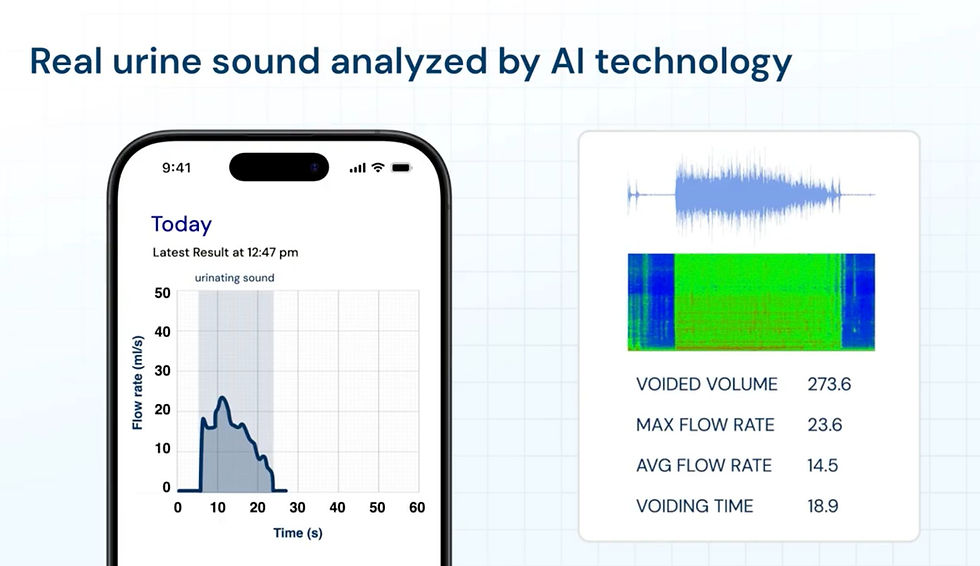
Our Moat: The Sound of Urination
At Soundable Health, our moat comes from something deeply human and incredibly difficult to replicate:the sound of urination.
We analyze not only the urine sound itself, but also the real-world factors that affect recording quality, including:
room acoustics
bathroom echoes
background noise from homes and public restrooms
microphone differences across smartphone models
This diversity matters — because health doesn’t happen in a lab.
Teaching AI What Pee Actually Sounds Like
In the early days, my co-founder and I worked closely with clinicians to train our first models.
We listened to thousands of de-identified recordings, teaching the AI what each sound truly meant.
Why this mattered:
No simulator can reproduce human bladder contraction
No synthetic data captures urinary channel elasticity
Turbulent urine flow behaves differently every time
That's why we are proud of proudP's 96% accuracy (it's not why our app is called proudP but the sentiment is there).
From In-House Recordings to 500,000+ Sound Data Points
Our dataset began humbly:
early in-house recordings (yes, the founding team’s data is in there 🚽)
carefully labeled and validated with clinical context
Over time, it expanded into:
IRB-approved clinical studies
real-world recordings from 50,000+ homes
Today, proudP is powered by over 500,000 sound data points, forming one of the most unique health datasets anywhere.

proudP is an at-home urine flow test app that uses acoustic AI to measure urine flow with your smartphone — no clinic visit required.
Beyond Urine: Hearing What the Body Can’t Show
This sound-first approach didn’t stop with urination.
We’ve expanded our acoustic AI platform into:
cough analytics
sleep-related sound patterns
early exploratory signals in brain health
Because sometimes, the next frontier in healthcare isn’t something you see.
It’s something you hear.
Related Questions
How can I get the proudP app?
You can download the app from Apple AppStore or Google PlayStore.
No extra hardware is required for the measurements, but just your phone.
How is a uroflow test done?
The traditional way is that you urinate into a special device that records the flow over time. There are no catheters or needles involved.
proudP is the modern way that enables patients to measure their urine flow naturally at home in a private setting using only a smartphone. By leveraging acoustic AI/DL technology, proudP gives the convenience and discreet way of testing uroflow at home.
You can repeat tests over time without visiting the clinic, generate longitudinal data that better reflects everyday urinary function and support proactive action, post-operative monitoring, and remote follow-up.
How does proudP work?
proudP measures urine flow using just a smartphone, no extra hardware.
When you urinate, proudP captures the sound using the smartphone’s microphone. And our proprietary and patented AI/DL model turns that sound into uroflow parameters, including:
Peak flow rate (Qmax)
Average flow rate
Voiding time
Flow pattern (curve shape)
Step-by-step
1) Open the proudP app
2) Place the smartphone nearby
3) Hit the START button to record
4) Empty your bladder naturally
5) Tap the FINISH button
Try out proudP Online IPSS!

