
What to Expect After a Prostate Procedure, and When to Worry

You just had a procedure for your prostate. Now you are home, and you are wondering what is normal and what is not.
That is a fair question, and a common one. The first stretch after a prostate procedure can be a little bumpy, and it helps to know what to expect so you do not worry over things that are simply part of healing.
This guide walks you through the early days, the first few months, and the signs that mean you should call your doctor.
In short: Some discomfort and changing symptoms are normal in the first weeks after a prostate procedure. Things often keep improving over the first few months, so try not to judge the result too early. But a few signs do mean you should call your doctor right away. And if you are not clearly better after a few months, that is worth bringing up.
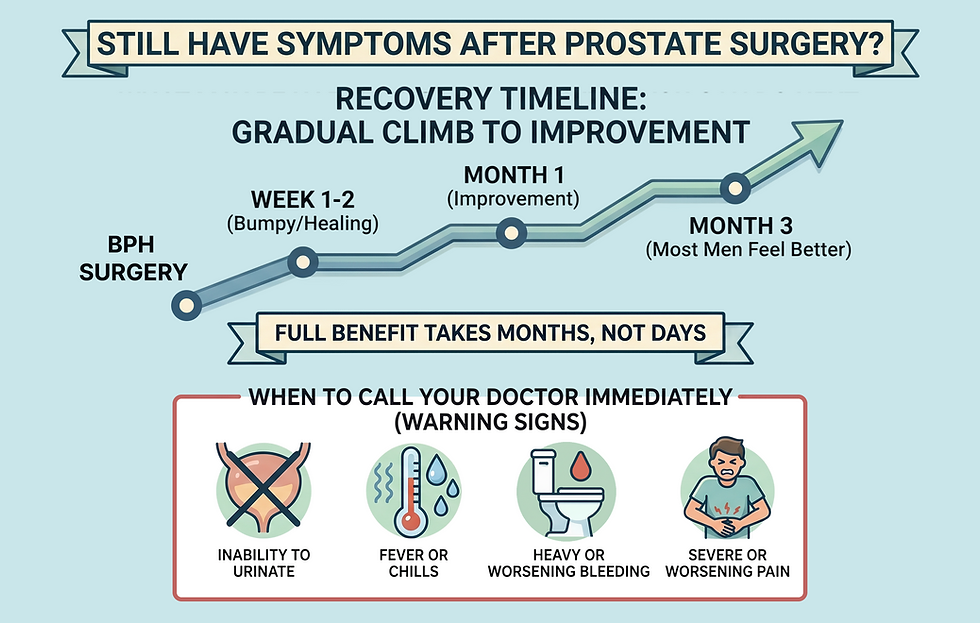
Table of Contents
The first days and weeks: some bumps are normal
The first few months: give it time to settle
When to call your doctor
If you are not better after a few months
The bottom line
The first days and weeks: some bumps are normal
In the early days, it is common to have some irritation when you go. You might feel like you need to go more often, or more urgently, than before. You might see a little blood at times. None of that is unusual right after a procedure.
Your body is healing, and the area is sensitive. Most of these early symptoms settle down on their own as you recover.
This is especially true for procedures that use heat or steam to shrink the prostate tissue. The treated tissue needs time to be reabsorbed by the body, and while that happens the area can swell, so for a few weeks symptoms may feel more intense rather than better. This is expected and not a sign the procedure failed. As the tissue heals and the swelling goes down, the improvement follows.
So try not to read too much into how you feel in the first week or two. This is the bumpy stretch. It is not the final result.
The first few months: give it time to settle
Here is something important. A prostate procedure often keeps improving for weeks to months. The full benefit is not always there on day one, and urologists who do these procedures will tell you the same. Many men keep getting better over the following weeks.
That is why it is wise not to judge the outcome too early. Feeling underwhelmed at your first checkup does not mean it did not work. Many men keep getting better over the following weeks.
Your doctor will usually want to see you for a follow-up visit in the first few months. That visit is a good time to talk through how you are doing and to check that things are on track.
A simple way to help yourself here is to keep track of your progress. Tools like proudP let you measure your urine flow at home with your phone. Over those first months, that shows you and your doctor whether things are truly improving, which is far more useful than trying to remember how a given week felt.
Recovery timeline: what is normal, and when
|
When to call your doctor
While some bumps are normal, a few things are not, and they are worth a prompt call to your doctor. Reach out if you:
Cannot pass urine at all. This needs attention right away.
Have a fever, chills, or burning that gets worse. This can be a sign of infection.
See heavy bleeding, or bleeding that is getting worse instead of better.
Have pain that is severe or not improving.
When in doubt, call. Your care team would rather hear from you than have you wait at home and worry.
If you are not better after a few months
Most men improve. But if you reach the few-month mark and you are still not clearly better, that is also a reason to go back.
This does not mean you are stuck. It often means there is one more thing to look at. Sometimes the prostate part worked, but the bladder or another cause is keeping symptoms going. Your doctor can check and find out.
For some men, symptoms return over time, and a second treatment is sometimes needed down the road. This is a known and accepted part of managing an enlarged prostate, not a sign that anything went wrong or that you did something wrong. If it happens to you, you are far from alone.
The key is not to wait too long in silence. Many issues are easier to sort out when they are caught early, in those first few months, rather than after a year of hoping it will fix itself.
The bottom line
Recovery after a prostate procedure is usually a gradual climb, not a switch that flips overnight. Expect some early bumps. Give it a few months to settle. Watch for the few warning signs that mean you should call. And if you are not clearly better by then, go back and say so.
Healing takes a little patience. But you should never feel you are on your own with it. Your doctor is your partner through the whole recovery, so use them.
Common questions
How long until a prostate procedure works?
It varies, but improvement often continues over weeks to months rather than appearing all at once. Try not to judge the result in the first week or two.
What is normal in the first weeks after a prostate procedure?
Some irritation, more frequent or urgent trips, and occasional light blood can be normal early on as you heal, and these often settle on their own.
When should I call my doctor after a prostate procedure?
Call promptly if you cannot pass urine, have a fever or worsening burning, see heavy or worsening bleeding, or have severe or worsening pain.
What if I am still not better after a few months?
Go back to your doctor. It does not mean you are stuck. Often there is one more cause to find and treat, and earlier is easier.
This article is for general education. It is not medical advice. Talk to your doctor about your symptoms and any warning signs.


